
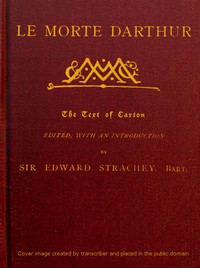
Le Morte d’Arthur
£2.99
The definitive English-language telling of King Arthur, Camelot, and the Round Table, compiled from French and English romance by a knight writing from prison.
📖 Look Inside — Free Sample
LE MORTE DARTHUR
------------------------------------------------------------------------
[Illustration]
------------------------------------------------------------------------
LE MORTE DARTHUR
_Sir Thomas Malory’s Book of King Arthur and of his Noble Knights of the Round Table_
=The Text of Caxton=
_EDITED, WITH AN INTRODUCTION_
SIR EDWARD STRACHEY, BART.
Si quando indigenas revocabo in carmina reges, Arturumque etiam sub terris bella moventem; Aut dicam invictae sociali foedere mensae Magnanimos Heroas.—MILTON.
=London= MACMILLAN AND CO. AND NEW YORK 1893
------------------------------------------------------------------------
Oxford
HORACE HART, PRINTER TO THE UNIVERSITY
------------------------------------------------------------------------
FRANCES STRACHEY
HER FATHER INSCRIBES THIS BOOK
THE INTRODUCTION TO WHICH
COULD NOT HAVE BEEN NOW RE-WRITTEN
WITHOUT HER HELP
IN MAKING THE EAR FAMILIAR WITH WORDS
WHICH THE EYE CAN NO LONGER READ.
------------------------------------------------------------------------
ADVERTISEMENT TO THE PRESENT EDITION.
The Introduction to the first edition of this volume included an account of the Text in the various editions of Sir Thomas Malory’s ‘Morte Darthur,’ and an attempt to estimate the character and worth of his book. The publication of Dr. Sommer’s edition of the Text and Prolegomena, demands that I should complete my bibliography by an account of this important work; and it enables me, by help of this learned writer’s new information, to confirm, while enlarging, my former criticism. I have, therefore, revised and re-written the two first sections of the Introduction. The Essay on Chivalry remains, but for a few verbal changes, as it was first printed.
SUTTON COURT,
_November, 1891_.
------------------------------------------------------------------------
CONTENTS.
INTRODUCTION.
§1. THE AUTHORSHIP AND MATTER OF THE BOOK.
PAGE
Origin of the Book.—Its claim to be called a poem.—Epic in plan.—Malory’s use of the old romances.—His History and Geography.—Camelot.—Glastonbury.—Almesbury.—Joyous Gard.—The Sangreal.—Influence on our language, letters, life.—Morality of the Book.—Spenser, Milton, Tennyson.—Malory, Caxton
§2. THE TEXT AND ITS SEVERAL EDITIONS.
The edition of Caxton, 1485.—Those of Wynkyn de Worde, 1498 and 1529.—Of Copland, 1557.—Of East, without date.—Of Stansby, 1634.—Editions of 1816.—Southey’s edition of 1817.—Discovery of interpolations in that edition.—Mr. Wright’s editions, 1858 and 1866.—Character and object of the present edition.—Abridgements.—Extracts.—Dr. Sommer’s edition, 1889-91
xxxi
§3. AN ESSAY ON CHIVALRY.
Origin of Chivalry.—Contest of Civilization with Barbarism.—The Chevalier and the Knight.—His education.—Amadis and Oriana.—The Black Prince.—Birth not essential to Knighthood.—The Lady.—Queen Philippa.—Decay of Chivalry.—Knights of Malta.—Modern Manners
xxxviii
THE BOOK OF KING ARTHUR
PREFACE OF WILLIAM CAXTON 1
THE TABLE OR RUBRYSSHE OF THE CONTENTS OF CHAPTERS 3
THE BOOK OF KING ARTHUR, BOOKS I TO XXI 25
NOTES 488
GLOSSARY AND INDEX 493
------------------------------------------------------------------------
INTRODUCTION.
§1. THE AUTHORSHIP AND MATTER OF THE BOOK.
ORIGIN OF THE BOOK.
We owe this our English Epic of Le Morte Darthur to Sir Thomas Malory, and to William Caxton the first English printer. Caxton’s Preface shows (what indeed would have been certain from his appeal to the ‘Knights of England’ at the end of ‘The Order of Chivalry’) that however strongly he, ‘William Caxton, simple person,’ may have been urged to undertake the work by ‘divers gentlemen of this realm of England,’ he was not less moved by his own love and reverence for ‘the noble acts of chivalry,’ and his deep sense of his duty and responsibility in printing what he believed would be for the instruction and profit of his readers, ‘of whatever estate or degree.’ But to Sir Thomas Malory he gives all the honour of having provided him with the copy which he printed. And ever since, for more than four hundred years, successive generations have approved the fitness of Caxton’s choice. For it is Malory’s book, and not the older forms of King Arthur’s story which we still read for enjoyment, and for the illustration of which scholars edit those earlier books. Only a true poem, the offspring of genius, could have so held, and be still holding its ground, age after age. It may be said that it is chiefly with boys, and with men who have formed the taste by their boyish reading, that the book is so popular. But is not this so with the Iliad too? Men of mature intellect and taste read and re-read the Iliad with ever new discoveries, appreciation, and enjoyment; but it may be questioned whether there are many, or even any, of them who did not begin those studies at school, and learn to love Homer before they knew that he was worthy of their love. And they who have given most of such reading, in youth and in manhood, to Malory’s Morte Darthur will be the most able and ready to recognise its claim to the character of an Epic poem.
MALORY A POET.
Malory wrote in prose, but he had ‘the vision and the faculty divine’ of the poet, though ‘wanting the accomplishment of verse’; and, great as that want is, we may apply Milton’s test of ‘simple, sensuous, and passionate,’ and we shall find no right to these names more real than is Malory’s. Every incident, the description of every event, is ‘simple,’ that is to say, complete in itself, while making a part of the whole story. The story is ‘sensuous,’ like that of Homer, and as every true poem must be, it is a living succession of concrete images and pictures, not of abstractions or generalized arguments and reasonings. These are the characteristics of the book, from its opening story of Igraine, which ‘befell in the days of Uther Pendragon,’ down to the death of the last four remaining knights who ‘went into the Holy Land, there as Jesus Christ was quick and dead,’ and there ‘did many battles upon the miscreants or Turks, and there they died on a Good Friday for God’s sake.’ And for ‘passion,’ for that emotion which the poet first feels in a special manner, and then awakens in his hearers, though they could not have originated it in themselves, with the adventures of the Round Table and the San Greal, or the deaths of Arthur, of Guenever, and of Launcelot, we may compare the wrath of Achilles, its cause and its consequences, or the leave-taking of Hector and Andromache. It would, indeed, be hard to find anywhere a pathos greater than that of Malory’s description of the death or ‘passing’ of Arthur, the penitence of Guenever, and her parting with Launcelot, or the lament of Launcelot over the King and Queen, and of Sir Ector over Launcelot himself. The first is too long to quote, but I may say that Malory has re-cast the old story, and all the poetry is his own. I give the two last:—
‘Truly, said Sir Launcelot, I trust I do not displease God, for He knoweth mine intent, for my sorrow was not, nor is not, for any rejoicing of sin, but my sorrow may never have end. For when I remember of her beauty, and of her noblesse, that was both with her king and with her; so when I saw his corpse and her corpse so lie together, truly mine heart would not serve to sustain my careful body. Also when I remember me, how by my default, mine orgule, and my pride, that they were both laid full low, that were peerless that ever was living of christian people, wit you well, said Sir Launcelot, this remembered, of their kindness and mine unkindness, sank so to my heart, that I might not sustain myself.’
And again:—
‘Ah, Launcelot, he said, thou were head of all christian knights; and now I dare say, said Sir Ector, thou Sir Launcelot, there thou liest, that thou were never matched of earthly knight’s hand; and thou were the courtiest knight that ever bare shield; and thou were the truest friend to thy lover that ever bestrode horse; and thou were the truest lover of a sinful man that ever loved woman; and thou were the kindest man that ever strake with sword; and thou were the goodliest person ever came among press of knights; and thou was the meekest man and the gentlest that ever ate in hall among ladies; and thou were the sternest knight to thy mortal foe that ever put spear in the rest[1].’
The former passage is all Malory’s own: the beauty of the latter is enhanced, if we set by its side the old version which he follows:—
‘Alas, sir [said] Bors, that I was born, That ever I should see this indeed, The beste knight his life hath lorn, That ever in stoure [fight] bestrode a steed, Jesu, that crowned was with thorn, In heaven his soul foster and feed[2].’
Humour is akin to passion; and it may not be out of place to notice here Malory’s vein of humour, as shown, for instance, in the way in which he tells the adventures of La Cote Male Taile, and of Beaumains; the pranks of the braver knights with Dinadan and Dagonet; the story of Arthur’s wedding feast, when a lady who ‘cried and made great dole,’ was forcibly carried out of the hall by a strange knight, and Arthur ‘was glad, for she made such a noise,’ and was thereupon rebuked by Merlin for thinking so lightly of his royal and knightly duties; or that of the usurper Mordred and the Bishop of Canterbury, when after each had defied the other, the bishop ‘did the curse in the most orgulous wise that might be done,’ and then retired to live ‘in poverty and holy prayers, for well he understood that mischievous war was at hand.’
THE BOOK EPIC IN PLAN.
In the Drama the action is present, actually unwinding itself and going on before our eyes. The Epic is the story of the past, a cycle of events completed, while through the one and the other may be traced a thread of destiny and providence, leading either to a happy triumph over circumstances, or to a tragic doom, which, too, is in the end, a triumph also. Thomas Hughes, the early Elizabethan dramatist, in his ‘Misfortunes of Arthur,’ concentrated and deepened the horror of such a tragedy by transferring the guilt of Launcelot to Mordred the son of Arthur and his unknown sister. He would better have recognised and followed the finer art of Malory. For though the motive of Malory’s epic is less gross and exaggerated than that of Hughes’s drama, the thread of guilt and doom which runs from first to last through the former is not less real than in the latter. The crime of Uther Pendragon, with which the story opens, leads to the concealment of Arthur’s parentage from himself, and this to his illicit love for her whom he does not know to be his sister, and so to the birth of Mordred. Then comes the prophetic doom:—‘Ye have done of late a thing that God is displeased with you: and your sister shall have a child that shall destroy you and all the knights of your realm.’ Arthur tries in vain to prevent the fulfilment of this doom by the only cruel deed of his life: and then—after another warning of the woe which his marriage with Guinevere will bring on him, through her guilty love for Launcelot—these germs of tragic destiny remain hidden through long years of prosperity. Arthur, aided by his fellowship of the Round Table, reduces universal anarchy into order: and not only ‘gets into his hand’ all England, Wales, and Scotland, but by his march to Rome makes himself emperor, and the head of all the kingdoms as well as of all the chivalry of Christendom. Still the fame and the honour of the king and his knights of the Round Table open continually into new and brighter forms, which seem above the reach of any adverse fate, till the coming of the Sancgreal, into the quest of which all the knights enter with that self-reliance which had become them so well in the field of worldly chivalry, but which would be of no avail now. They are now to be tried by other tests than those by which they had been proved as ‘earthly knights and lovers,’ tests which even Launcelot, Ector de Maris, Gawaine, and the other chiefest of the fellowship could not stand. The quest is achieved by the holy knights alone: two depart from this life to a higher, while Sir Bors, not quite spotless, yet forgiven and sanctified, the link between the earthly and the spiritual worlds, returns to aid in restoring the glory of the feasts and tournaments at Camelot and Westminster. But the curse is at work: the severance between good and evil which had been declared through the Sancgreal cannot be closed again; and the tragic end comes on, in spite of the efforts—touching from their very weakness—of Arthur and Launcelot to avert the woe, the one by vainly trying to resist temptation, the other by refusing to believe evil of his wife and his dearest friend. The black clouds open for a moment as the sun goes down; and we see Arthur in the barge which bears him to the Holy Isle; Guenever, the nun of Almesbury, living in fasting, prayers, and almsdeeds; and Launcelot with his fellowship, once knights but now hermit-priests, ‘doing bodily all manner of service.’
Nor are the marks of harmony and unity less plain in the several characters than in the events of the story. Arthur is a true knight, sharing the characteristics of his nobler knights, yet he differs from them all in showing also that he is, and feels himself to be, a king; as when—with an imperiousness which reminds us of Froissart’s story of Edward III refusing to listen to Sir Walter of Manny’s remonstrances on behalf of the burgesses of Calais—he tells Sir Launcelot that he ‘takes no force whom he grieves,’ or insists on his entering the lists against a tired knight whom he is not willing to see victorious over the whole field; or as when he sadly regrets that he cannot do battle for his wife, though he believes her innocent, but must be a rightful judge according to the laws. There are many others of the Round Table who are ‘very perfect gentle knights, yet we feel that Launcelot stands distinct among them all in the pre-eminence of his knightliness, notwithstanding his one great sin. Thus, to take one of many instances, who but Launcelot would have borne the taunts and the violence of Gawaine with his humble patience and ever-renewed efforts for a reconciliation, when he was leaving the realm, and when he was besieged in Joyous Gard. Modern critics of great name agree in censuring Sir Thomas Malory for departing from the old authorities who represented Gawaine as the very counterpart of Launcelot in knightly character: but I rather see a proof of Malory’s art in giving us a new Gawaine with a strongly individual character of his own. Gawaine’s regard for his mother’s honour, his passion for Ettard, and his affection for his brothers, are fierce impulses driving him to unknightly and unworthy deeds, yet he is far from being represented as a mere savage. If Malory depicts him thirsting to revenge upon Launcelot the unintentional killing of Gaheris and Gareth, he depicts also his long previous affection for Launcelot and his opposition to the hostility of his other brother, Mordred, against him; his devotion to his uncle Arthur; his hearty repentance towards Launcelot at the last; and his entreaty that he would ‘see his tomb, and pray some prayer more or less for his soul.’ Nor must we forget that it was by the prayer of those ladies for whom Gawaine had ‘done battle in a rightwise quarrel,’ that his ghost was permitted to give Arthur a last warning. Distinct again from the character of this fierce knight is that of the Saracen Palamides, whose unquestionable courage and skill in deeds of chivalry also want—though in another way than Gawaine’s—the gentleness, the meekness, and the delicate sense of honour of the Christian knight. Sir Dinadan again, who can give and take hard knocks if need be, though he has no great bodily strength, and who is always bantering the good knights who know and esteem him with his humorous protests against love and arms, is a distinctly drawn character. So is Merlin, half Christian, half magician, but always with dog-like loyalty to the house of Uther Pendragon. So is the Bishop of Canterbury, who appears at intervals in the story. So are many others whose names I might recite. The dignity of queen Guenever towards her husband and her court is not less marked than her guilty passion for Launcelot, and the unreasoning jealousy it excites in her. The wife-like simplicity of Igraine, the self-surrender beyond all limit, though from different impulses, of the two Elaines, the pertness of the damsel Linet, and the piety and self-sacrifice of Sir Percivale’s sister, will occur to the reader among the distinctive characteristics of the different ladies and damsels who live and move, each in her own proper form, in the story. Sir Thomas Malory, as we know, found many of these men and women already existing in the old romances as he represents them to us; but we may believe that those earlier books were to him something of what the pages of Plutarch and Holinshed were to Shakespeare.
Description
The definitive English-language telling of King Arthur, Camelot, and the Round Table, compiled from French and English romance by a knight writing from prison.
By Thomas Malory. Included free with your Luxpress subscription — or buy it individually for £2.99 to download and keep permanently, even if you cancel.
Reviews
There are no reviews yet.