
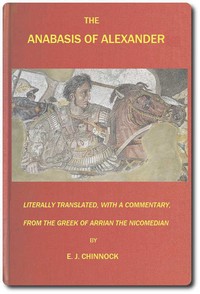
The Anabasis of Alexander
£1.99
Arrian’s campaign history follows Alexander the Great from Macedon to India, drawing on eyewitness accounts written by the general’s own officers.
📖 Look Inside — Free Sample
THE
ANABASIS OF ALEXANDER.
THE
ANABASIS OF ALEXANDER;
OR,
The History of the Wars and Conquests of Alexander the Great.
_LITERALLY TRANSLATED, WITH A COMMENTARY, FROM THE GREEK OF ARRIAN THE NICOMEDIAN_,
E. J. CHINNOCK, M.A., LL.B., LONDON,
_Rector of Dumfries Academy_.
London:
HODDER AND STOUGHTON,
27, PATERNOSTER ROW.
MDCCCLXXXIV.
Butler & Tanner, The Selwood Printing Works, Frome, and London.
PREFACE.
When I began this Translation, more than two years ago, I had no intention of publishing it; but as the work progressed, it occurred to me that Arrian is an Author deserving of more attention from the English-speaking races than he has yet received. No edition of his works has, so far as I am aware, ever appeared in England, though on the Continent many have been published. In the following Translation I have tried to give as literal a rendering of the Greek text as I could without transgressing the idioms of our own language. My theory of the duty of a Translator is, to give the _ipsissima verba_ of his Author as nearly as possible, and not put into his mouth words which he never used, under the mistaken notion of improving his diction or his way of stating his case. It is a comparatively easy thing to give a paraphrase of a foreign work, presenting the general drift of the original; but no one, unless he has himself tried it, can understand the difficulty of translating a classical Author correctly without omission or mutilation.
In the Commentary which I have compiled, continual reference has been made to the other extant authorities on the history of Alexander, such as Diodorus, Plutarch, Curtius, Justin, and Aelian; so that I think I may safely assert that, taking the Translation and the Notes together, the book forms a complete history of Alexander’s reign. Much geographical and other material has also been gathered from Herodotus, Strabo, Pliny, and Ammianus; and the allusions to the places which are also mentioned in the Old Testament are given from the Hebrew.
As Arrian lived in the second century of the present era, and nearly five hundred years after Demosthenes, it is not to be expected that he wrote classical Greek. There are, however, at least a dozen valuable Greek authors of this century whose works are still extant, and of these it is a safe statement to make, that Arrian is the best of them all, with the single exception of Lucian. I have noticed as many of his deviations from Attic Greek constructions as I thought suitable to a work of this kind. A complete index of Proper Names has been added, and the quantities of the vowels marked for the aid of the English Reader. In the multiplicity of references which I have put into the Notes, I should be sanguine if I imagined that no errors will be found; but if such occur, I must plead as an excuse the pressure of work which a teacher in a large school experiences, leaving him very little energy for literary labour.
E. J. C.
DUMFRIES, _December, 1883_.
CONTENTS.
PAGE
Life and Writings of Arrian 1
Arrian’s Preface 6
BOOK I.
CHAP.
I. Death of Philip and Accession of Alexander.—His Wars with the Thracians 8
II. Battle with the Triballians 12
III. Alexander at the Danube and in the Country of the Getae 14
IV. Alexander destroys the City of the Getae.—The Ambassadors of the Celts 16
V. Revolt of Clitus and Glaucias 18
VI. Defeat of Clitus and Glaucias 22
VII. Revolt of Thebes (_September_, B.C. 335) 25
VIII. Fall of Thebes 28
IX. Destruction of Thebes 31
X. Alexander’s Dealings with Athens 34
XI. Alexander crosses the Hellespont and visits Troy 36
XII. Alexander at the Tomb of Achilles.—Memnon’s advice Rejected by the Persian Generals 38
XIII. Battle of the Granicus (B.C. 334) 41
XIV. Arrangement of the Hostile Armies 43
XV. Description of the Battle of the Granicus 45
XVI. Defeat of the Persians.—Loss on Both Sides 47
XVII. Alexander in Sardis and Ephesus 50
XVIII. Alexander marches to Miletus and Occupies the Island of Lade 52
XIX. Siege and Capture of Miletus 55
XX. Siege of Halicarnassus.—Abortive Attack on Myndus 58
XXI. Siege of Halicarnassus 61
XXII. Siege of Halicarnassus 63
XXIII. Destruction of Halicarnassus.—Ada, Queen of Caria 64
XXIV. Alexander in Lycia and Pamphylia 66
XXV. Treason of Alexander, Son of Aëropus 68
XXVI. Alexander in Pamphylia.—Capture of Aspendus and Side 70
XXVII. Alexander in Phrygia and Pisidia 72
XXVIII. Operations in Pisidia 74
XXIX. Alexander in Phrygia 76
BOOK II.
I. Capture of Mitylene by the Persians.—Death of Memnon 78
II. The Persians capture Tenedus.—They are Defeated at Sea 80
III. Alexander at Gordium 82
IV. Conquest of Cappadocia.—Alexander’s Illness at Tarsus 84
V. Alexander at the Tomb of Sardanapalus.—Proceedings in Cilicia 87
Description
Arrian’s campaign history follows Alexander the Great from Macedon to India, drawing on eyewitness accounts written by the general’s own officers.
By Arrian. Included free with your Luxpress subscription — or buy it individually for £1.99 to download and keep permanently, even if you cancel.



Reviews
There are no reviews yet.