
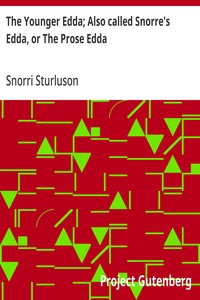
The Prose Edda
£1.99
Snorri Sturluson’s 13th-century guide to Norse mythology, the source for most of what we know about Odin, Thor, and the end of the world at Ragnarök.
📖 Look Inside — Free Sample
THE YOUNGER EDDA:
also called
SNORRE’S EDDA, OR THE PROSE EDDA.
An English Version of the Foreword; The Fooling of Gylfe, The Afterword; Brage’s Talk, The Afterword to Brage’s Talk, and the Important Passages in the Poetical Diction (Skaldskaparmal).
with an
Introduction, Notes, Vocabulary, and Index.
By RASMUS B. ANDERSON, LL.D.,
Formerly Professor of the Scandinavian Languages in the University of Wisconsin, Ex-U.S. Minister to Denmark, Author of “America Not Discovered By Columbus,” “Norse Mythology,” “Viking Tales Of The North,” etc.
Chicago Scott, Foresman and Company 1901
Copyright, 1879, By S. C. Griggs and Company.
Press of The Henry O. Shepard Co. Chicago.
HON. THOS. F. BAYARD,
Ambassador to the Court of St. James, in Grateful Recollection of Pleasant Official Relations.
PREFACE.
In the beginning, before the heaven and the earth and the sea were created, the great abyss Ginungagap was without form and void, and the spirit of Fimbultyr moved upon the face of the deep, until the ice-cold rivers, the Elivogs, flowing from Niflheim, came in contact with the dazzling flames from Muspelheim. This was before Chaos.
And Fimbultyr said: Let the melted drops of vapor quicken into life, and the giant Ymer was born in the midst of Ginungagap. He was not a god, but the father of all the race of evil giants. This was Chaos.
And Fimbultyr said: Let Ymer be slain and let order be established. And straightway Odin and his brothers--the bright sons of Bure--gave Ymer a mortal wound, and from his body made they the universe; from his flesh, the earth; from his blood, the sea; from his bones, the rocks; from his hair, the trees; from his skull, the vaulted heavens; from his eye-brows, the bulwark called Midgard. And the gods formed man and woman in their own image of two trees, and breathed into them the breath of life. Ask and Embla became living souls, and they received a garden in Midgard as a dwelling-place for themselves and their children until the end of time. This was Cosmos.
The world’s last day approaches. All bonds and fetters that bound the forces of heaven and earth together are severed, and the powers of good and of evil are brought together in an internecine feud. Loke advances with the Fenris-wolf and the Midgard-serpent, his own children, with all the hosts of the giants, and with Surt, who flings fire and flame over the world. Odin advances with all the asas and all the blessed einherjes. They meet, contend, and fall. The wolf swallows Odin but Vidar, the Silent, sets his foot upon the monster’s lower jaw, he seizes the other with his hand, and thus rends him till he dies. Frey encounters Surt, and terrible blows are given ere Frey falls. Heimdal and Loke fight and kill each other, and so do Tyr and the dog Garm from the Gnipa Cave. Asa-Thor fells the Midgard-serpent with his Mjolner, but he retreats only nine paces when he himself falls dead, suffocated by the serpent’s venom. Then smoke wreathes up around the ash Ygdrasil, the high flames play against the heavens, the graves of the gods, of the giants and of men are swallowed up by the sea, and the end has come. This is Ragnarok, the twilight of the gods.
But the radiant dawn follows the night. The earth, completely green, rises again from the sea, and where the mews have but just been rocking on restless waves, rich fields unplowed and unsown, now wave their golden harvests before the gentle breezes. The asas awake to a new life, Balder is with them again. Then comes the mighty Fimbultyr, the god who is from everlasting to everlasting; the god whom the Edda skald dared not name. The god of gods comes to the asas. He comes to the great judgment and gathers all the good into Gimle to dwell there forever, and evermore delights enjoy; but the perjurers and murderers and adulterers he sends to Nastrand, that terrible hall, to be torn by Nidhug until they are purged from their wickedness. This is Regeneration.
These are the outlines of the Teutonic religion. Such were the doctrines established by Odin among our ancestors. Thus do we find it recorded in the Eddas of Iceland.
The present volume contains all of the Younger Edda that can possibly be of any importance to English readers. In fact, it gives more than has ever before been presented in any translation into English, German or any of the modern Scandinavian tongues.
We would recommend our readers to omit the Forewords and Afterwords until they have perused the Fooling of Gylfe and Brage’s Speech. The Forewords and Afterwords, it will readily be seen, are written by a later and less skillful hand, and we should be sorry to have anyone lay the book aside and lose the pleasure of reading Snorre’s and Olaf’s charming work, because he became disgusted with what seemed to him mere silly twaddle. And yet these Forewords and Afterwords become interesting enough when taken up in connection with a study of the historical anthropomorphized Odin. With a view of giving a pretty complete outline of the founder of the Teutonic race we have in our notes given all the Heimskringla sketch of the Black Sea Odin. We have done this, not only on account of the material it furnishes as the groundwork of a Teutonic epic, which we trust the muses will ere long direct some one to write, but also on account of the vivid picture it gives of Teutonic life as shaped and controlled by the Odinic faith.
All the poems quoted in the Younger Edda have in this edition been traced back to their sources in the Elder Edda and elsewhere.
Where the notes seem to the reader insufficient, we must refer him to our Norse Mythology, where he will, we trust, find much of the additional information he may desire.
Well aware that our work has many imperfections, and begging our readers to deal generously with our shortcomings, we send the book out into the world with the hope that it may aid some young son or daughter of Odin to find his way to the fountains of Urd and Mimer and to Idun’s rejuvenating apples. The son must not squander, but husband wisely, what his father has accumulated. The race must cherish and hold fast and add to the thought that the past has bequeathed to it. Thus does it grow greater and richer with each new generation. The past is the mirror that reflects the future.
R. B. ANDERSON. University of Wisconsin, Madison, Wis., _September, 1879_.
CONTENTS.
Preface 5
Introduction 15
Foreword 33
THE FOOLING OF GYLFE.
CHAPTER I. Gefjun’s Plowing 49
CHAPTER II. Gylfe’s Journey to Asgard 51
CHAPTER III. Of the Highest God 54
CHAPTER IV. The Creation of the World 56
CHAPTER V. The Creation (continued) 64
CHAPTER VI. The First Works of the Asas--The Golden Age 69
CHAPTER VII. On the Wonderful Things in Heaven 72
CHAPTER VIII. The Asas 79
CHAPTER IX. Loke and his Offspring 91
CHAPTER X. The Goddesses (Asynjes) 97
CHAPTER XI. The Giantess Gerd and Skirner’s Journey 101
CHAPTER XII. Life in Valhal 104
CHAPTER XIII. Odin’s Horse and Frey’s Ship 109
CHAPTER XIV. Thor’s Adventures 113
CHAPTER XV. The Death of Balder 131
CHAPTER XVI. Ragnarok 140
CHAPTER XVII. Regeneration 147
Afterword to the Fooling of Gylfe 151
BRAGE’S TALK.
CHAPTER I. Æger’s Journey to Asgard 152
CHAPTER II. Idun and her Apples 155
CHAPTER III. How Njord got Skade to Wife 158
CHAPTER IV. The Origin of Poetry 160
Afterword to Brage’s Talk 166
EXTRACTS FROM THE POETICAL DICTION.
Thor and Hrungner 169 Thor’s Journey to Geirrod’s 176 Idun 184 Æger’s Feast 187 Loke’s Wager with the Dwarfs 189 The Niflungs and Gjukungs 193 Menja and Fenja 206 The Grottesong 208 Rolf Krake 214 Hogne and Hild 218
NOTES.
Enea 221 Herikon 221 The Historical Odin 221 Fornjot and the Settlement of Norway 239 Notes to the Fooling of Gylfe 242 Note on the Niflungs and Gjukungs 266 Note on Menja and Fenja 267 Why the Sea is Salt 268
VOCABULARY 275
INDEX 291
Description
Snorri Sturluson’s 13th-century guide to Norse mythology, the source for most of what we know about Odin, Thor, and the end of the world at Ragnarök.
By Snorri Sturluson. Included free with your Luxpress subscription — or buy it individually for £1.99 to download and keep permanently, even if you cancel.


Reviews
There are no reviews yet.