
Hamlet
£0.99
A Danish prince feigns madness to avenge his murdered father, and talks himself into the most famous indecision in literature.
📖 Look Inside — Free Sample
Transcriber's Note: This is a heavily edited version of _Hamlet_. It was used for Charles Kean's 1859 stage production. Phrases printed in italics in the book are indicated in this electronic version by _ (underscore). Footnotes originally appeared at the bottom of each page. For this electronic version the footnotes are collected at the end of each act. In Act I, Scene 5, the word Uumix'd has been changed to Unmix'd. A closing bracket ] was added to Act IV footnote 37 after _Naked on your kingdom_,. A closing bracket ] was added to Act IV footnote 50 after _Venom'd stuck_,. The word o'er-crows appears in Act V, Scene 3; in footnote V.81, o'ercrows appears without a hyphen. Both are as they appear in the book.
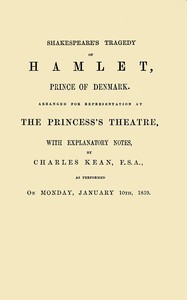
SHAKESPEARE'S TRAGEDY
HAMLET, PRINCE OF DENMARK.
ARRANGED FOR REPRESENTATION AT THE Royal Princess's Theatre
WITH EXPLANATORY NOTES,
BY CHARLES KEAN, F.S.A.
AS PERFORMED ON MONDAY, JANUARY 10, 1859.
LONDON:
BRADBURY AND EVANS, 11, BOUVERIE STREET. 1859.
LONDON: BRADBURY AND EVANS, PRINTERS, WHITEFRIARS.
Dramatis Personæ
CLAUDIUS (_King of Denmark_) Mr. RYDER.
HAMLET (_son to the former and_ _nephew to the present King_). Mr. CHARLES KEAN.
POLONIUS (_Lord Chamberlain_) Mr. MEADOWS.
HORATIO (_friend To Hamlet_) Mr. GRAHAM.
LAERTES (_son To Polonius_) Mr. J. F. CATHCART.
ROSENCRANTZ } { Mr. BRAZIER. GUILDENSTERN } (_Courtiers_) { Mr. G. EVERETT. OSRICK } { Mr. DAVID FISHER.
PRIEST Mr. TERRY.
MARCELLUS Mr. PAULO.
BERNARDO Mr. DALY.
FRANCISCO Mr. COLLETT.
GHOST OF HAMLET'S FATHER Mr. WALTER LACY.
FIRST GRAVEDIGGER Mr. FRANK MATTHEWS.
SECOND GRAVEDIGGER Mr. H. SAKER.
FIRST PLAYER Mr. F. COOKE.
SECOND PLAYER Mr. ROLLESTON.
GERTRUDE (_Queen of Denmark, and_ _mother of Hamlet_) Mrs. CHARLES KEAN.
OPHELIA (_daughter of Polonius_) Miss HEATH.
ACTRESS Miss DALY.
STAGE DIRECTIONS.
R. H. means Right Hand; L. H. Left Hand; U. E. Upper Entrance; R. H. C. Enters through the Centre from the Right Hand; L. H. C. Enters through the Centre from the Left Hand.
RELATIVE POSITIONS OF THE PERFORMERS WHEN ON THE STAGE.
R. means on the Right side of the Stage; L. on the Left side of the Stage; C. Centre of the Stage; R. C. Right Centre of the Stage; L. C. Left Centre of the Stage.
The reader is supposed _to be on the Stage_, facing the audience.
PREFACE.
The play of _Hamlet_ is above all others the most stupendous monument of Shakespeare's genius, standing as a beacon to command the wonder and admiration of the world, and as a memorial to future generations, that the mind of its author was moved by little less than inspiration. _Lear_, with its sublime picture of human misery;--_Othello_, with its harrowing overthrow of a nature great and amiable;--_Macbeth_, with its fearful murder of a monarch, whose "virtues plead like angels trumpet-tongued against the deep damnation of his taking off,"--severally exhibit, in the most pre-eminent degree, all those mighty elements which constitute the perfection of tragic art--the grand, the pitiful, and the terrible. _Hamlet_ is a history of mind--a tragedy of thought. It contains the deepest philosophy, and most profound wisdom; yet speaks the language of the heart, touching the secret spring of every sense and feeling. Here we have no ideal exaltation of character, but life with its blended faults and virtues,--a gentle nature unstrung by passing events, and thus rendered "out of tune and harsh."
The original story of Hamlet is to be found in the Latin pages of the Danish historian, Saxo Grammaticus, who died in the year 1208. Towards the end of the sixteenth century, the French author, Francis de Belleforest, introduced the fable into a collection of novels, which were translated into English, and printed in a small quarto black letter volume, under the title of the "Historie of Hamblett," from which source Shakespeare constructed the present tragedy.
Saxo has placed his history about 200 years before Christianity, when barbarians, clothed in skins, peopled the shores of the Baltic. The poet, however, has so far modernised the subject as to make Hamlet a Christian, and England tributary to the "sovereign majesty of Denmark." A date can therefore be easily fixed, and the costume of the tenth and eleventh centuries may be selected for the purpose. There are but few authentic records in existence, but these few afford reason to believe that very slight difference existed between the dress of the Dane and that of the Anglo-Saxon of the same period.
Since its first representation, upwards of two centuries and a half ago, no play has been acted so frequently, or commanded such universal admiration. It draws within the sphere of its attraction both the scholastic and the unlearned. It finds a response in every breast, however high or however humble. By its colossal aid it exalts the drama of England above that of every nation, past or present. It is, indeed, the most marvellous creation of human intellect.
CHARLES KEAN.
HAMLET,
PRINCE OF DENMARK.
ACT I.
SCENE I.--ELSINORE. A PLATFORM BEFORE THE CASTLE. NIGHT.
FRANCISCO _on his post. Enter to him_ BERNARDO (L.H.)
_Ber._ Who's there?
_Fran._ (R.) Nay, answer me:[1] stand, and unfold[2] yourself.
_Ber._ Long live the king![3]
_Fran._ Bernardo?
_Ber._ He.
_Fran._ You come most carefully upon your hour.
_Ber._ 'Tis now struck twelve; get thee to bed, Francisco.
_Fran._ For this relief much thanks:
[_Crosses to_ L.]
'tis bitter cold, And I am sick at heart.
_Ber._ Have you had quiet guard?
_Fran._ Not a mouse stirring.
_Ber._ Well, good night. If you do meet Horatio and Marcellus, The rivals of my watch,[4] bid them make haste.
_Fran._ I think I hear them.--Stand, ho! Who's there?
_Hor._ Friends to this ground.
_Mar._ And liegemen to the Dane.[5]
Description
A Danish prince feigns madness to avenge his murdered father, and talks himself into the most famous indecision in literature.
By William Shakespeare. Included free with your Luxpress subscription — or buy it individually for £0.99 to download and keep permanently, even if you cancel.



Reviews
There are no reviews yet.